From Early Lasers to Modern Proctology Care
Is this the future?
Lasers have been used in proctology—the care of the anus and rectum—for several decades. Early systems in the 1980s and 1990s used carbon dioxide or Nd lasers mainly to cut or seal tissue during haemorrhoid surgery. The hope was simple: less bleeding, less pain and a quicker recovery.
An older-generation Sharplan 40C carbon dioxide surgical laser. Its large cabinet and jointed delivery arm show how bulky early surgical laser systems could be. Image: Etan J. Tal/Wikimedia Commons, CC BY-SA 3.0.
Some early results were encouraging. A 1989 Japanese study followed 1,816 people treated for haemorrhoids and described good pain relief and a more comfortable recovery.[1] In 1991, a trial of 88 patients in Taiwan found that laser treatment reduced the need for strong pain relief and shortened hospital stays.[2] However, a 1993 American trial found no clear patient benefit over a scalpel and noted more wound problems and higher costs.[3] Laser care still needed to improve.
The major change came with thinner diode lasers and flexible fibres. Instead of using a laser simply as a cutting tool, surgeons could place a fibre inside a haemorrhoid or fistula tract. Heat is delivered in a controlled way, causing the tissue to shrink and seal while limiting damage around it.
The modern biolitec LEONARDO® DUAL 45. This compact system uses 980 nm and 1470 nm wavelengths and works with fine fibres made for different procedures. Image: biolitec® Holding GmbH & Co KG.
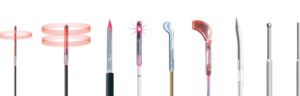
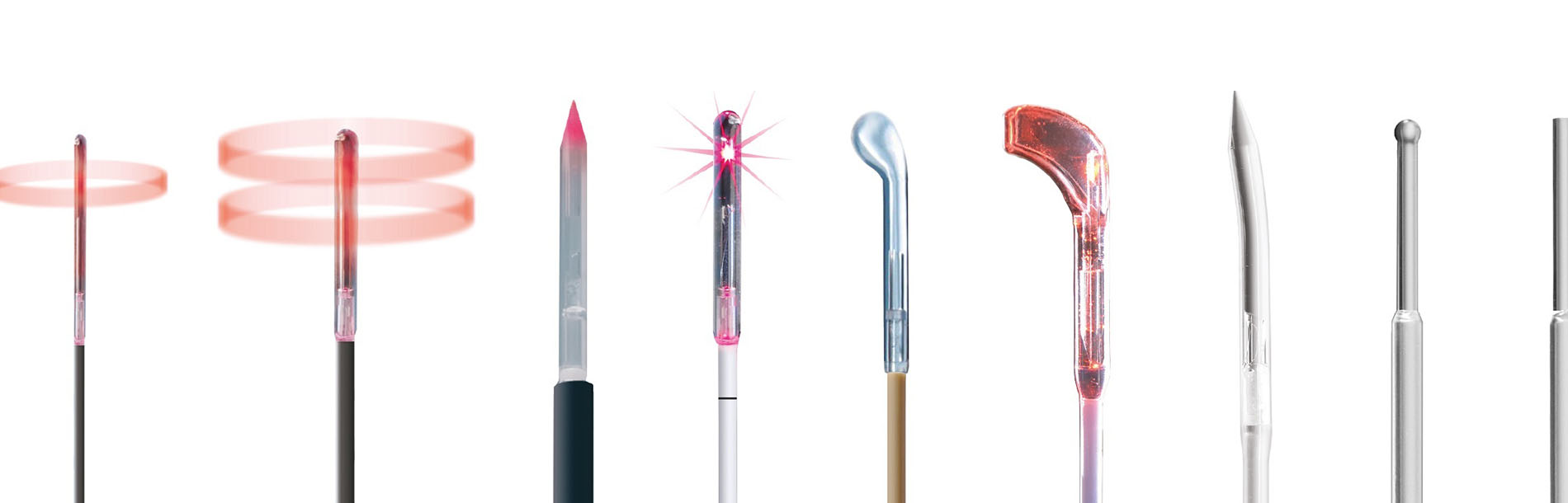
The fine FiLaC® fibre delivers laser energy around the inside of a fistula tract. This is very different from using a laser as a large cutting tool. Image: biolitec® Holding GmbH & Co KG.
This helped laser treatment spread through Europe, Asia, the Middle East and other regions. A 2017 randomised trial found that laser treatment for grade II and III haemorrhoids caused less early pain and bleeding than traditional surgery, with similar results at one year.[4] A 2023 review of nine studies and 661 patients also found less pain and a lower need for pain medicine after laser haemorrhoidoplasty.[5]
Laser fistula closure, known as FiLaC, was first reported in its modern form in Germany in 2011.[6] A 2020 review of 454 patients found that about two-thirds of fistulas healed after the first treatment. Problems affecting bowel control were uncommon.[7] This was important because protecting the anal muscles can protect continence.
Interest has grown in the UK too. British specialist teams have published research,[8] and NICE issued guidance for laser fistula treatment in 2019.[9] Use remains careful because the quality of long-term evidence is still limited.
Laser is not a cure-all. Haemorrhoids may be better treated with diet changes, medicines, banding or standard surgery. A simple fistula may heal more reliably after a lay-open operation, while a complex fistula may need a seton or another muscle-saving method. The best treatment depends on the condition, its stage and the person’s priorities—not on the newest machine.
Appendix: References
- Iwagaki H, Higuchi Y, Fuchimoto S, Orita K. “The laser treatment of hemorrhoids: results of a study on 1816 patients.” Japanese Journal of Surgery. 1989;19(6):658–661. PubMed.
- Wang JY, Chang-Chien CR, Chen JS, Lai CR, Tang RP. “The role of lasers in hemorrhoidectomy.” Diseases of the Colon & Rectum. 1991;34(1):78–82. PubMed.
- Senagore A, Mazier WP, Luchtefeld MA, MacKeigan JM, Wengert T. “Treatment of advanced hemorrhoidal disease: a prospective, randomized comparison of cold scalpel versus contact Nd laser.” Diseases of the Colon & Rectum. 1993;36(11):1042–1049. PubMed.
- Naderan M, Shoar S, Nazari M, Elsayed A, Mahmoodzadeh H, Khorgami Z. “A randomized controlled trial comparing laser intra-haemorrhoidal coagulation and Milligan–Morgan haemorrhoidectomy.” Journal of Investigative Surgery. 2017;30(5):325–331. PubMed.
- Wee IJY, Koo CH, Seow-En I, Ng YYR, Lin W, Tan EJKW. “Laser hemorrhoidoplasty versus conventional hemorrhoidectomy for grade II/III hemorrhoids: a systematic review and meta-analysis.” Annals of Coloproctology. 2023;39(1):3–10. PubMed.
- Wilhelm A. “A new technique for sphincter-preserving anal fistula repair using a novel radial emitting laser probe.” Techniques in Coloproctology. 2011;15(4):445–449. PubMed.
- Elfeki H, Shalaby M, Emile SH, Sakr A, Mikael M, Lundby L. “A systematic review and meta-analysis of the safety and efficacy of fistula laser closure.” Techniques in Coloproctology. 2020;24(4):265–274. PubMed.
- Adegbola SO, Sahnan K, Tozer P, Warusavitarne J. “Emerging data on fistula laser closure for the treatment of perianal fistulas: patient selection and outcomes.” Clinical and Experimental Gastroenterology. 2021;14:467–475. PubMed.
- National Institute for Health and Care Excellence. “Radially emitting laser fibre treatment of an anal fistula.” HealthTech Guidance 505. Published 2019. NICE guidance.